The premise
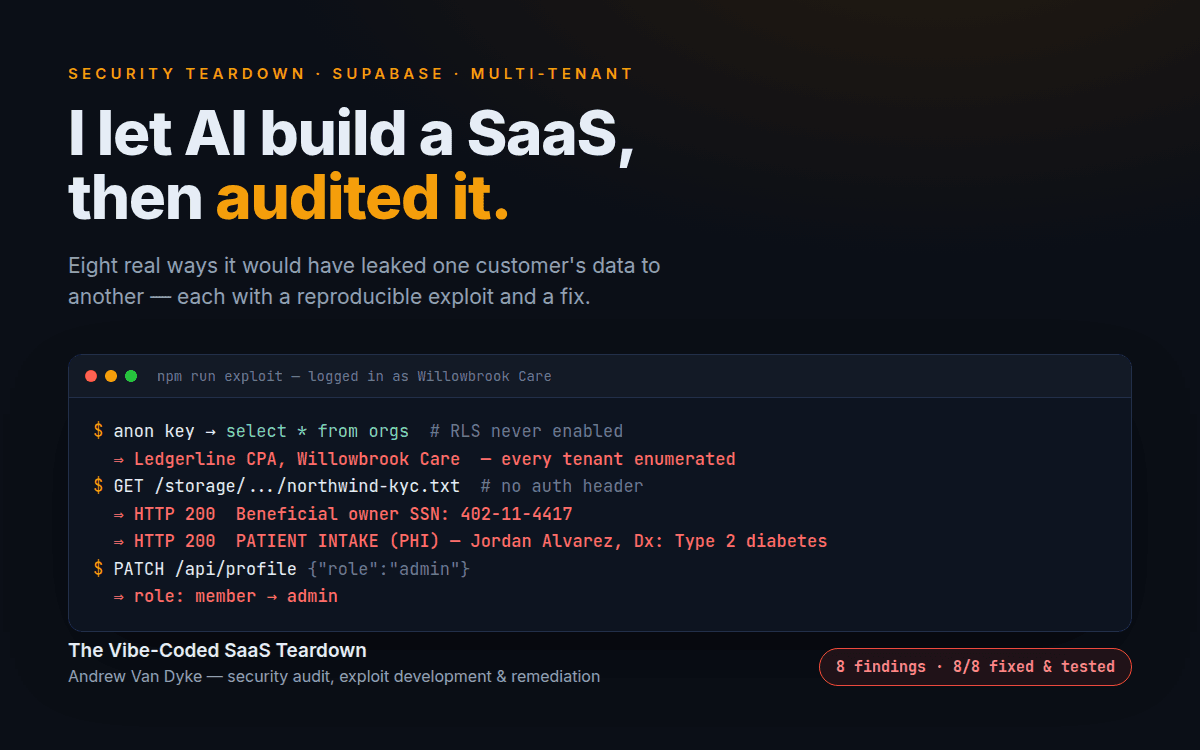
Teams are shipping production SaaS scaffolded by AI faster than anyone can review it. The code runs. It demos beautifully. And in a multi-tenant app it is often one missing line away from handing every customer's data to every other customer.
So I ran the experiment honestly: I had an AI scaffold a realistic B2B client portal - the kind an accounting firm or a care-management practice would actually buy - with orgs, users, invoices, documents, and a team page. Then I audited it the way I audit client code: assume nothing, log in as one tenant, and try to read another's data.
It had eight distinct ways to do exactly that. None of them are exotic. Every one is a real mistake I've seen in production Supabase apps, and every one passes a casual test - because in single-tenant dev, with one company and one happy-path click-through, nothing looks wrong.
Two tenants are seeded throughout: Ledgerline CPA (accounting) and Willowbrook Care (healthcare). Everything below is logged in as one, reading the other.
Ethics. This is my own app, my own throwaway database, seeded entirely with fake data. Nothing here touches a real system or real customer. The vulnerable branch and the fixed branch are both public; the diff between them is the audit.
Why Supabase makes this the whole ballgame
Supabase hands your Postgres database directly to the browser through a public
"anon" key. A logged-in user's browser can literally run select * from invoices. The only thing standing between them and every other firm's rows is
Row-Level Security (RLS) - policies attached to each table that filter which
rows a caller may see.
That means RLS isn't a nice-to-have layer on top of your access control. In
Supabase it is your access control. A single table with RLS off, or a policy
that says using (true), is not a bug ticket - it's a data breach. Six of the
eight findings below live exactly there.
The eight findings
1 - RLS never enabled on a table · Critical
What the AI shipped. It enabled RLS on the tables it was thinking about
(invoices, documents) and simply never enabled it on orgs. No policy, no
protection.
The exploit. With nothing but the public anon key - not even logged in:
const supabase = createClient(SUPABASE_URL, ANON_KEY);
const { data } = await supabase.from("orgs").select("*");
// → 2 rows: "Ledgerline CPA" (accounting), "Willowbrook Care" (healthcare)
Every tenant on the platform, enumerable by anyone who opens the site. That's the customer list, and it's the org IDs that make the later attacks precise.
Why it passed the casual test. In dev there's one org. select * from orgs
returns "your" org and looks perfectly scoped. The hole only appears once a
second tenant exists - i.e. in production.
The fix. Enable RLS and scope to the caller's org:
alter table public.orgs enable row level security;
create policy "orgs: own org only" on public.orgs for select
  using (id = public.current_org_id());
Takeaway: RLS is opt-in per table. "I added policies" is not the same as "every table is covered." Audit the list, not the highlights.
2 - A child table with no policy · Critical
What the AI shipped. invoices got a correct, org-scoped policy. Its child
table line_items - same financial data, one join away - got none.
The exploit. Not even logged in:
await supabase.from("invoices").select("*");    // → 0 rows. RLS holds.
await supabase.from("line_items").select("*");  // → 8 rows. Every firm's detail.
// $600.00  Northwind Traders  -  advisory retainer
// $600.00  Cedar Family Practice  -  advisory retainer  ← different tenant
The front door is locked; the side door is wide open. Anyone reads every firm's invoice line items directly.
Why it passed the casual test. The invoices page works and is protected.
Nobody clicks a URL that queries line_items directly - but an attacker with
the anon key doesn't use your UI.
The fix. Enable RLS on the child and scope it through its parent:
alter table public.line_items enable row level security;
create policy "line_items: own org only" on public.line_items for select
  using (invoice_id in (
    select id from public.invoices where org_id = public.current_org_id()
  ));
Takeaway: protection doesn't inherit across foreign keys. Every table that holds tenant data needs its own policy - especially the boring child tables.
3 - A policy that checks existence, not ownership · Critical
What the AI shipped. profiles looks locked down - it has RLS on and a
policy. The policy is using (true).
create policy "Profiles are viewable by authenticated users"
  on public.profiles for select using (true);
The exploit. Log in as Willowbrook's most junior member and read the user table:
await supabase.auth.signInWithPassword({ email: "raj@willowbrook.test", ... });
const { data } = await supabase.from("profiles").select("*");
// → 4 rows across BOTH orgs: dana@ledgerline, sam@ledgerline,
//   nora@willowbrook, raj@willowbrook
using (true) means "is there any session?" - not "does this row belong to
you?" Every authenticated user reads every user in the database.
Why it passed the casual test. There's a green checkmark next to "RLS enabled." Dashboards report the table as protected. It takes reading the predicate to see that it protects nothing.
The fix. Scope by ownership. (And beware the trap: a profiles policy that
selects from profiles recurses infinitely - Postgres error 42P17. The standard
fix is a security definer helper that resolves the caller's org without
re-triggering RLS.)
create function public.current_org_id() returns uuid
  language sql stable security definer set search_path = public
as $$ select org_id from public.profiles where id = auth.uid() $$;

create policy "profiles: own org only" on public.profiles for select
  using (org_id = public.current_org_id());
Takeaway: "has a policy" ≠ "has the right policy." using (true) is a lock with
no tumblers.
4 - The service-role key shipped to the browser · Critical
What the AI shipped. The dashboard needed a count across all rows; the anon
client (correctly) couldn't see them, so the quick fix reached for the
service-role client - in a "use client" component, reading
NEXT_PUBLIC_SUPABASE_SERVICE_ROLE_KEY.
The exploit. The NEXT_PUBLIC_ prefix bakes that key into the JavaScript
every visitor downloads. It's not hypothetical - the audit found the full
service-role JWT sitting in a shipped bundle:
service_role JWT present in browser JS?  true
  → /_next/static/chunks/app/dashboard/page.js
The service-role key bypasses RLS entirely. Whoever reads it owns the database
- every org's SSNs, internal notes, everything:
const godmode = createClient(SUPABASE_URL, LEAKED_KEY_FROM_BUNDLE);
await godmode.from("profiles").select("email, ssn_last4, internal_notes");
// dana@ledgerline  ssn_last4=4417  "Managing partner. Comp: $310k…"
// nora@willowbrook ssn_last4=7781  "Clinic director. DEA# on file…"
Why it passed the casual test. It works. The dashboard shows its number. Nothing errors. The key is invisible unless you open devtools - which the developer never does, and the attacker always does.
The fix. Delete the file. Service-role keys are server-only, full stop; the widget uses the ordinary anon client and is scoped by RLS like everything else.
Takeaway: NEXT_PUBLIC_ is a publish button. Any secret behind it is already
public. A service-role key never touches client code.
5 - Authorization enforced only in React · High
What the AI shipped. An admin-only revenue dashboard. The /admin page
hides the link with if (role === "admin"). The API route behind it,
/api/admin/revenue, checks that you're logged in - and never checks your role.
The exploit. Log in as a member and call the endpoint the UI never showed you:
// signed in as sam@ledgerline.test  -  role: "member"
await fetch("/api/admin/revenue", { headers: { Authorization: `Bearer ${token}` }});
// → HTTP 200  { report: "firm-revenue", total_cents: 605000, … }
Hiding the button is not access control.
Why it passed the casual test. Log in as an admin (the developer's own account) and everything's correct - the link shows, the page loads. The bug only exists for the users who aren't supposed to see it, and you're never testing as them.
The fix. Enforce the role on the server, where the data is:
const { data: me } = await supabase.from("profiles").select("role").eq("id", user.id).single();
if (me?.role !== "admin") return NextResponse.json({ error: "forbidden" }, { status: 403 });
Takeaway: the client decides what to render; the server decides what's allowed. Every privileged route re-checks, regardless of what the UI shows.
6 - The server trusts the client's input · High
What the AI shipped. A "update your profile" endpoint that writes whatever the client sends straight to the row:
const CLIENT_EDITABLE = ["full_name", "role", "org_id", "email"];
The form only exposes full_name, so in testing it only ever changes the name.
The exploit. Send a field the form doesn't - and promote yourself:
// signed in as sam@ledgerline.test  -  role: "member"
await fetch("/api/profile", { method: "PATCH",
  headers: { Authorization: `Bearer ${token}`, "content-type": "application/json" },
  body: JSON.stringify({ role: "admin" }) });
// role before: member  →  role after: admin
Same class of bug lets you send org_id and move yourself into another firm.
Why it passed the casual test. The UI form physically can't send role, so
manual testing never triggers it. curl has no such manners.
The fix. The server owns the allowlist - one field, and it uses the caller's own token so the row-level UPDATE policy is a second line of defense:
const ALLOWED_FIELDS = ["full_name"]; // role and org_id are never client-writable
Takeaway: mass assignment is trusting the shape of a request. Decide server-side exactly which fields a user may change, and ignore the rest.
7 - A public storage bucket · High
What the AI shipped. KYC packets and patient intake forms uploaded to a
Supabase Storage bucket created with public: true. The documents table is
correctly RLS-scoped - but the files themselves have no access control at all.
The exploit. A raw fetch to the public object URL - no Authorization
header, no anon key, nothing:
GET /storage/v1/object/public/documents/<org>/northwind-kyc.txt
→ HTTP 200
  KYC  -  Northwind Traders | EIN: 84-1938271 | Beneficial owner SSN: 402-11-4417

GET /storage/v1/object/public/documents/<org>/alvarez-intake.txt
→ HTTP 200
  PATIENT INTAKE (PHI) | Name: Jordan Alvarez | DOB: 1984-03-12 | Dx: Type 2 diabetes
These URLs work for anyone, forever, with no expiry and no revocation. Forward
one in an email, leak one in a Referer header, and the PHI is gone.
Why it passed the casual test. The upload works, the download works, the app feels done. "Public" sounds like "shareable," not "world-readable."
The fix. Make the bucket private and serve files through short-lived signed URLs:
await supabase.storage.createBucket("documents", { public: false });
const { data } = await supabase.storage.from("documents").createSignedUrl(path, 60);
// a URL that authorizes one file for 60 seconds, then dies
Takeaway: a public bucket is a public URL for every file in it. Private KYC/PHI data belongs behind signed URLs, never a permanent public link.
8 - PII over-exposure by select('*') · Medium
What the AI shipped. The Team page renders each teammate's name and role.
The endpoint behind it does select('*') and returns the raw rows.
The exploit. The UI shows two columns; the JSON ships the whole table:
await fetch("/api/team", { headers: { Authorization: `Bearer ${token}` }});
// team[].ssn_last4      → "4417", "7781", …
// team[].internal_notes → "On PIP through Q3.", "DEA# on file.", …
SSNs and private HR notes, one devtools tab away, on a page that only ever draws a name. (Combined with finding #3, this leaks it across every tenant.)
Why it passed the casual test. The rendered page looks minimal and correct. The over-exposure is entirely in the network response nobody inspects.
The fix. Return only what the view needs:
await supabase.from("profiles").select("id, full_name, role"); // never select('*')
Takeaway: your API's contract is the JSON it returns, not the UI that consumes it. Project to the columns you actually render.
The fix branch: proving it, not just claiming it
Fixing the holes is table stakes. The fixed branch also ships a regression suite that encodes tenant isolation as tests - so the fixes can't silently rot:
✓ #1 orgs: anon cannot enumerate tenants
✓ #2 line_items: anon cannot read invoice detail
✓ #3 profiles: a member sees only their own org
✓ #4 service-role key is not in the browser bundle
✓ #5 admin API: member is forbidden, admin is allowed
✓ #6 profile: role cannot be changed by the client
✓ #7 storage: public URL is dead; signed URL works
✓ #8 team API: no PII columns, own org only

Test Files  1 passed (1)
     Tests  8 passed (8)
The main → fixed diff touches ten files: one remediation migration and a
handful of route and client changes. That small a diff, guarding that much data,
is the point.
What this demonstrates
Auditing AI-generated code is my most-recurring line of work, and this is what it actually looks like. The failure mode isn't incompetence - the code is clean and it runs. It's that AI scaffolding optimizes for the happy path in a single-tenant dev environment, which is exactly the environment where multi-tenant isolation bugs are invisible. Every finding here shipped green.
The value a senior engineer adds is the adversarial second pass: assume the anon key is hostile, log in as the wrong tenant, read the network tab, and check the predicate on every policy - then leave behind tests so it stays fixed. Eight findings, one weekend, on an app that looked finished.